

Tufting? You've always wanted to try it! But what equipment should you buy, and which gun should you use? Don't panic, this article is for you. We'll guide you so you can easily get started on your creative projects.
Tufting gun / tufting machine.
First, to practice tufting, as the name suggests, you’ll need a tufting gun, more commonly known as a "tufting machine." Depending on the result you want, would you prefer a CUT gun or a LOOP gun?
In fact, there is a difference between these two models: the finish
The CUT tufting gun (cut pile)
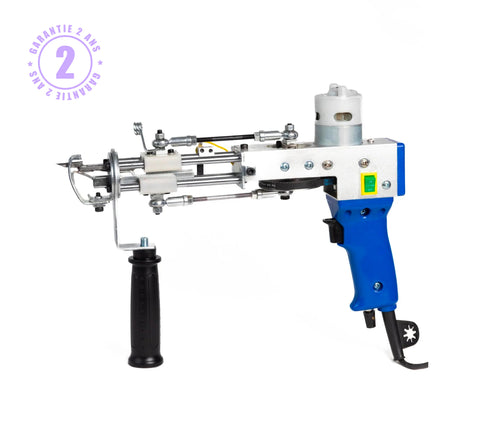
With the CUT tufting gun, the result will have a cut pile, meaning the machine cuts the wool yarn straight. You can usually adjust the yarn length between 7 and 20 mm on the tufting gun. Each time you press the trigger, the wool yarn will be cut, allowing you to make rugs faster.
The LOOP tufting gun (loop pile)
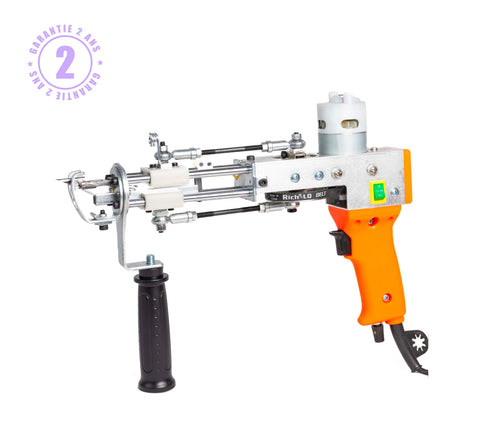
With the LOOP tufting gun, the result will have a loop pile. This technique takes longer, but the result is well worth it! When using a LOOP tufting gun, you’ll need to cut the yarn manually with your scissors once you’ve finished an area.
Tufting yarn

If you're new to tufting, we recommend starting out with acrylic yarn. It's more affordable, so you can experiment without worrying about your wallet. However, keep in mind that the higher the quality of your yarn, the longer your creations will last.
For the best results, we recommend using 2 strands of yarn at the same time in your machine.
There are many types of yarn, each with its own advantages and disadvantages. Acrylic yarn is resistant to dirt, mold, moths, and fading. Acrylic is more affordable than wool and comes in a wide range of colors. Unfortunately, it tends to pill and shed, so it doesn't hold the fabric as well. So choose acrylic for your creations if you plan to place them in a clean indoor space, rather than outdoors in a garden, for example.
Wool is considered a “premium” fiber because wool creations last longer. Wool comes as a single long strand (mesh-like) that stretches out to be knitted. If you’re making a rug for someone else or plan to sell it, we recommend using wool.
The fabric
Without suitable fabric, you won’t be able to work in the best conditions, so let’s take a look at fabrics to explain the importance of one of the essential elements of tufting.

After trying different qualities and testing many techniques on more or less rigid surfaces, we’re offering our own tufting fabric. This densely woven fabric is strong and hard to tear, so you can let your imagination run wild without any unpleasant surprises. We offer two premium white and gray polyester fabrics that won’t tear thanks to their thickness and quality weave.
Finally, you’ll need backing fabric to protect and professionally finish your tufted creations. There are several ways to do this, depending on what your rug will be used for (wall hanging, floor rug, clothing). Finishing your creation is important, as it may be intended for sale or as a gift. If so, it’s best to be prepared!

You can use a glue gun, spray adhesive, or carpet adhesive to attach your backing fabric. Finally, finish with binding tape to hide any “unfinished” edges and protect the whole piece.

The tufting frame

For tufting, you’ll also need to make yourself a frame to stretch the fabric over. On letufting.fr, you can buy pre-nailed strips (grippers) to hold the premium white or gray fabric.
The glue
 |
 |
 |
There are different types of glue for finishing your rugs. We recommend acrylic polymer or synthetic rubber glue, which we find to be the most effective. This is only a suggestion based on our experience and what we’ve tested, but other options may work just as well. We encourage you to try them out and tell us about your results on Instagram.
That said, here are some other types of glue you can find in most DIY stores, such as Leroy Merlin or Weldom, under names like “flooring adhesive” or “Soudal adhesive.”
Latex glue: Latex is traditionally used to hold the yarn in place. The biggest problem with latex is that it breaks down and crumbles over time. It’s important to use high-quality latex to slow down or prevent this from happening.
Polyvinyl acetate: PVA glue is inexpensive, easy to find, and non-toxic (you may know it as Elmer’s glue). It can be used for wall pieces and cushions. Note that the result will be stiffer.
Acrylic polymer-synthetic rubber adhesive: Acrylic polymers are used in the upholstery industry. Synthetic rubber’s advantage is that it bonds very well and doesn’t degrade over time like its natural counterpart.
One last tip: if you’re planning to make a rug, buy more glue! Small tubs aren’t enough; we often use more than we think.
Other things you might need…
Here’s a short list of other supplies you’ll need:
- A permanent marker for drawing on the fabric
- A thread snips or sewing scissors to cut stray threads from your work
- A trimmer to trim your rug evenly once it’s finished
- A spatula for applying the glue
- A glue gun or spray adhesive for attaching the backing fabric
- An overhead projector if you want to project your image/design for a professional finish
- Oil specially designed for maintaining your tufting gun
- A yarn threader, essential for threading yarn into your tufting gun
With all this in mind, we hope this guide will give you the key pointers for bringing your personal and professional projects to life.
Where can you find the products?
All the products you need for tufting are available in our tufting shop.
Now, ready, set, tuft!
0 comments